When we started consulting on SAP treasury, most of what we learned came from the projects themselves. We figured things out by doing: implementing, testing, and fixing what didn’t work the first time. Over the years, that added up to a practical understanding of how the pieces fit together, and a long list of lessons learned.
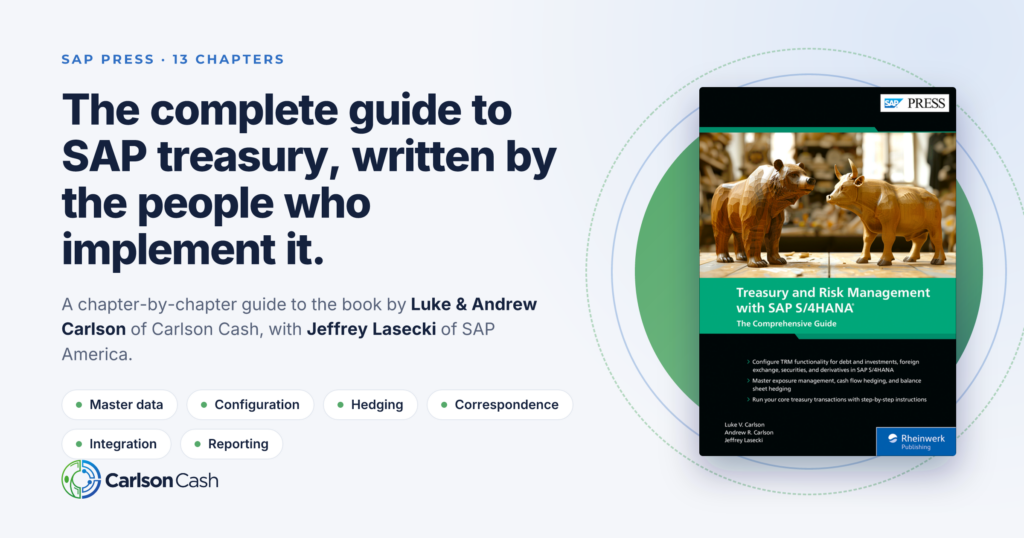
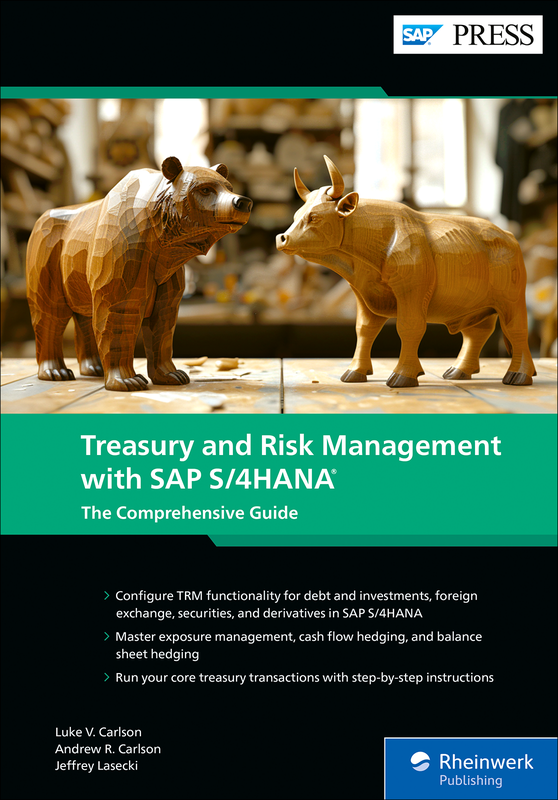
Treasury and Risk Management with SAP S/4HANA: The Comprehensive Guide (SAP PRESS, 2025) is our way of putting that experience in one place: 820 pages and 13 chapters covering SAP S/4HANA treasury from setup to reporting. It was written by Luke Carlson and Andrew Carlson of Carlson Cash with Jeffrey Lasecki of SAP America, and it draws on decades of combined implementation experience with Fortune 100 treasury teams.
Below is a walkthrough of what’s inside each chapter, so you can see whether it fits what your team needs.
Who the book is for
The book is written for two groups of readers. Consultants and configuration teams get step-by-step setup guidance with screenshots, plus the reasoning behind each setting. Treasury users (treasurers, analysts, and risk managers) get a detailed look at the day-to-day work: entering deals, approvals, settlement, month-end, hedging, and reporting.
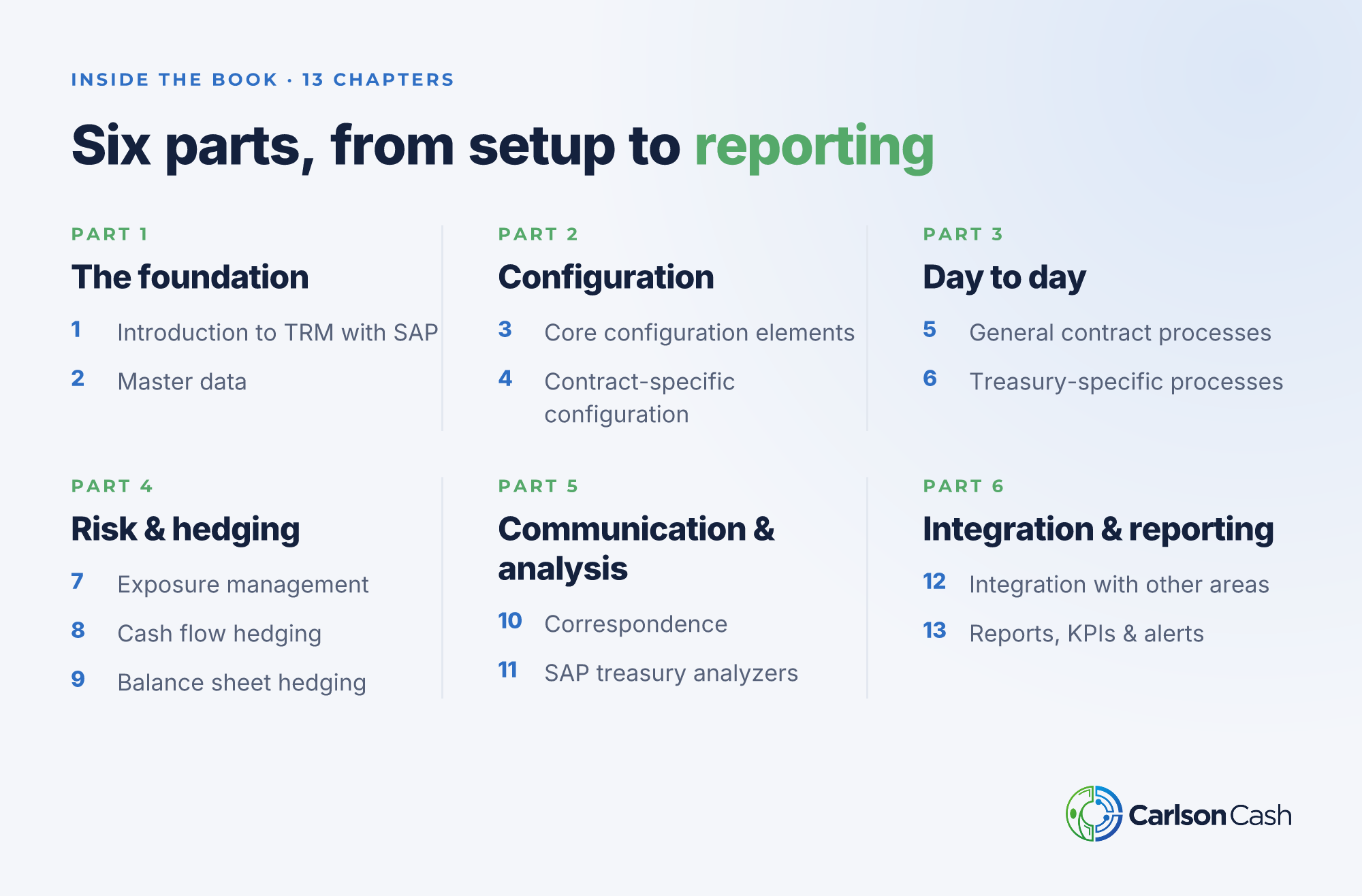
We also made a deliberate choice about scope. Rather than documenting every instrument SAP supports, the book focuses on the scenarios we see in most treasury departments. It’s built around the 95% of situations you’ll actually face, not rare edge cases.
Part 1: The foundation
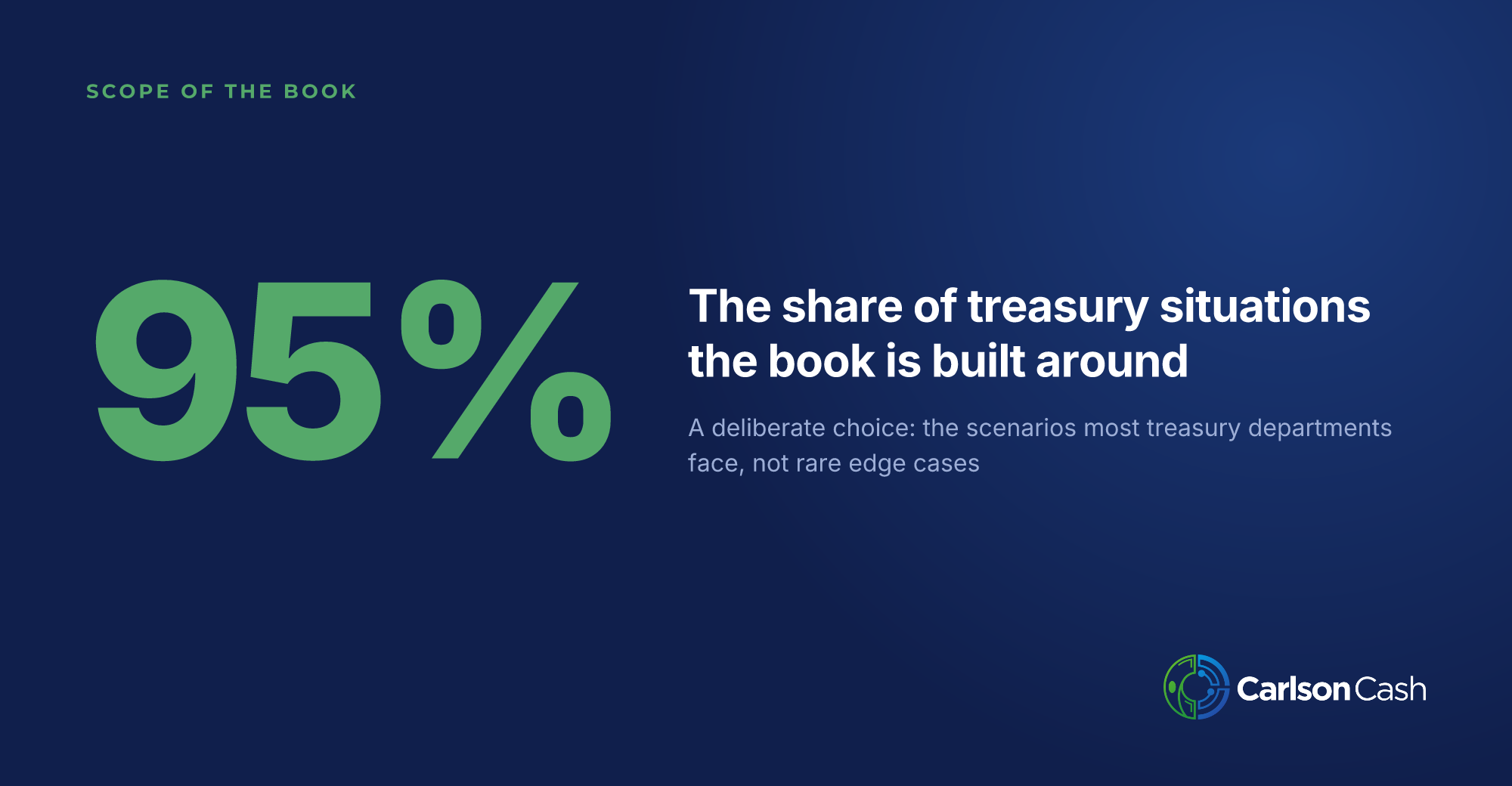
Chapter 1: Introduction to Treasury and Risk Management with SAP
Not long ago, there was a running joke in treasury consulting: the most widely used treasury system in the world was Excel. Chapter 1 starts with that joke and explains why it doesn’t hold up anymore. Modern treasury teams expect three things from their system: real-time data and analytics, built-in connections to trading platforms and other providers, and standardized processes and controls.
From there, the chapter gives an overview of SAP’s treasury solution, its current scope, and its core components. It also spends time on the SAP Fiori user experience, because treasury users who know how to tailor their screens get far more out of the system.
What you’ll learn:
- How SAP treasury has evolved and where it fits in a modern treasury function
- How to personalize SAP Fiori: user profiles, custom views, custom tiles, and sharing views with colleagues
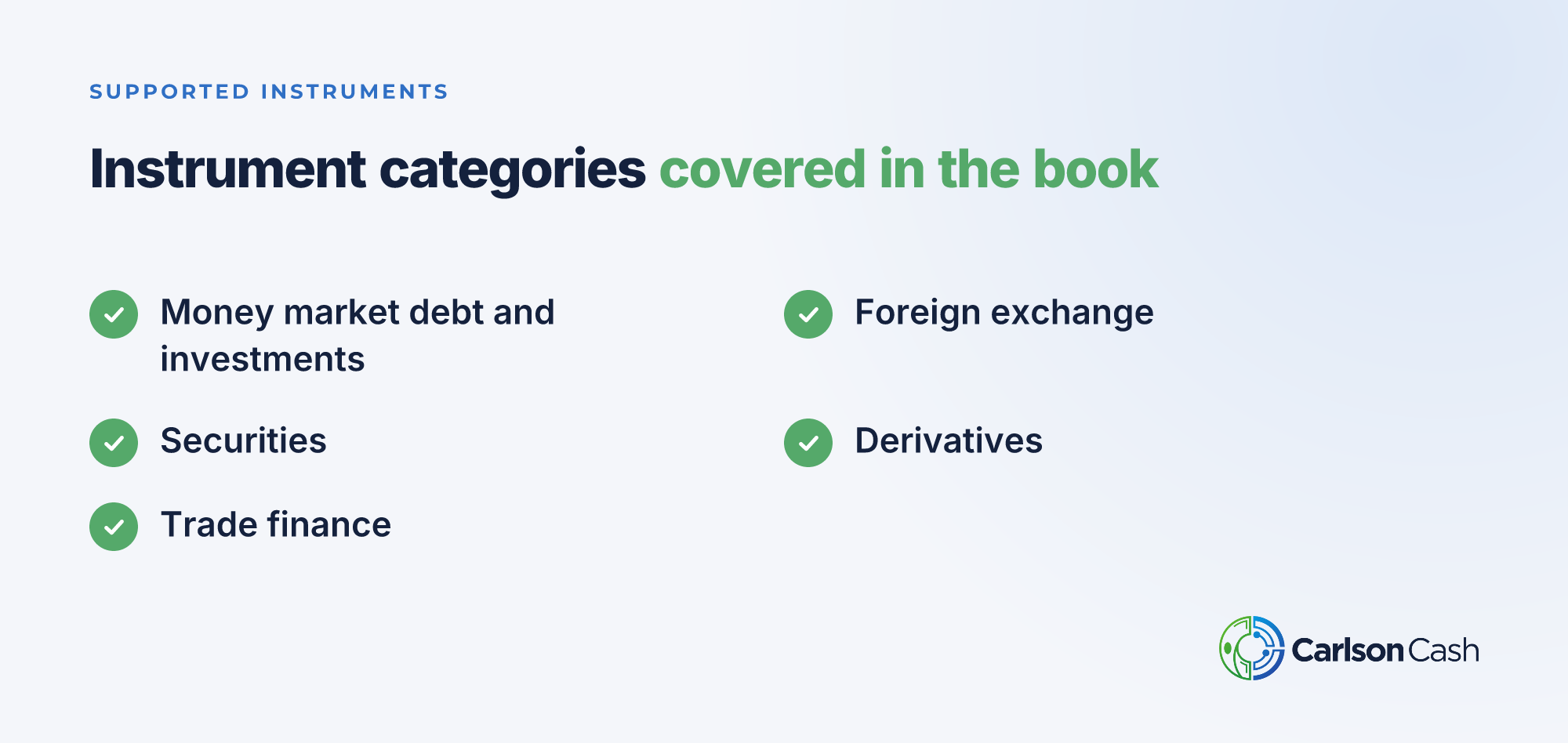
- The full range of supported instruments across five categories: money market debt and investments, foreign exchange, securities, derivatives, and trade finance
If you’re evaluating whether SAP can handle your instrument mix, this is the chapter to start with.
Chapter 2: Master Data
Everything in treasury runs on master data. When it’s wrong or incomplete, the problem rarely shows up right away. It shows up later as a failed posting, a payment that won’t go out, or a valuation that doesn’t make sense. Chapter 2 covers master data end to end and explains which processes depend on each piece.
What you’ll learn:
- Organizational and bank setup: company codes, the bank master, house banks, and house bank accounts
- Business partners, including maintenance, payment details, and authorizations
- Derivative contract specifications, calendars, and how to define and assign traders
- Market data: FX rates, swap rates, security prices, reference interest rates, yield curves, and commodity prices
- Market data interfaces for loading rates automatically instead of keying them in
Part 2: Configuration
Chapter 3: Core Configuration Elements
Whether you’re setting up simple commercial paper or a complex derivative, much of the configuration is the same. Chapter 3 covers that shared foundation in detail. Get it right, and every instrument you add later builds on it cleanly. Get it wrong, and the problems repeat across every instrument.
The chapter follows the logical order of building a new instrument, from organizational settings through to the general ledger.
What you’ll learn:
- Valuation setup: accounting codes, valuation areas, valuation classes, general valuation classes, and position management procedures
- Instrument building blocks: product categories, product types, transaction types, number ranges, and field selection
- Flow types, update types, and condition types, and how they connect to each other
- Accruals and deferrals, portfolios, administration fields, and release workflows for deal approval
- The complete accounting integration: account symbols, posting specifications, account assignment references, and position transfers
Chapter 4: Contract-Specific Configuration
With the core in place, Chapter 4 tailors the setup to the instruments corporate treasuries use most. Each section opens with how the instrument is used in practice, then walks through its configuration all the way to the accounting postings. The goal is for you to understand the patterns well enough to build variations for your own business, not just copy one example.
What you’ll learn:
- Debt and investments: money market contracts, intercompany loans, credit facilities, and letters of credit
- Foreign exchange: product and transaction types, fixing spreads, position management, nondeliverable currencies, and FX mirroring for trades between internal entities
- Securities: general configuration, transaction management, and position management
- Derivatives: flow, update, and condition types, valuation, and derived business transactions
- Commodity derivatives: commodity types, market identifier codes, exchanges, and the full product setup
Part 3: Running treasury day to day
Chapter 5: General Contract Processes
This is where the book moves from configuration to the user’s side. Chapter 5 lays out the standard lifecycle every treasury transaction follows, regardless of instrument. It shows how one central place to enter deals, run valuations, and generate accounting improves both control and decision-making.
What you’ll learn:
- The Create Financial Transaction app, screen by screen: the initial screen, header information, the structure tab, and the additional tabs
- Contract settlement and how it fits into your approval and control process
- Transaction posting: posting flows, running accruals and deferrals, key date valuations, and long-term to short-term reclassification
- Payment processing for treasury transactions
Chapter 6: Treasury Management–Specific Processes
Chapter 6 is the most hands-on chapter for treasury users. It covers the specific processing flow for each contract type you’ll handle regularly, with a process flow diagram and the actual screens for each one.
What you’ll learn:
- Debt and investments, including working with risk-free rates such as Term SOFR and Overnight SOFR after the move away from LIBOR, interest rate adjustments, and planned records
- Facilities, both bilateral and syndicated, and how drawings work against them
- Intercompany loans: contract creation, mirroring between entities, settlement, and changes
- Securities: accounts, classes, contracts, accounting postings, and one-off postings
- Foreign exchange: contract creation, posting, monthly processing, and settlement
- Interest rate swaps: entry, rate adjustments, cash flows, and mark-to-market valuation
- Trade finance (letters of credit) and commodity contracts, including cash and contract settlement
Part 4: Managing risk and hedging
Chapter 7: Exposure Management
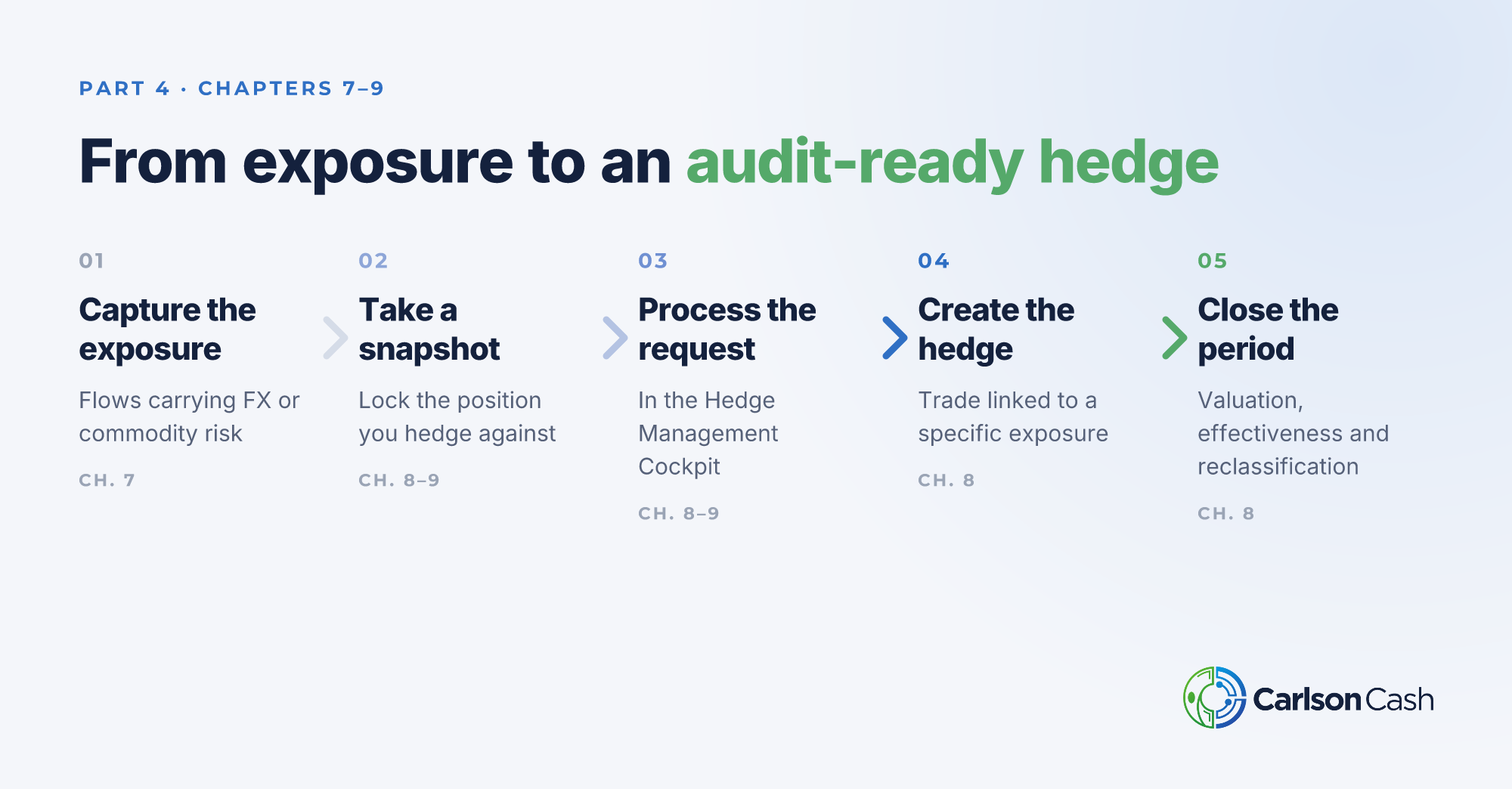
You can’t hedge what you can’t see. Chapter 7 covers Exposure Management 2.0, which captures the committed and forecasted cash flows that carry currency or commodity price risk. Typical sources are doing business in currencies other than your functional currency and buying or selling commodities with changing prices. These exposures are the building blocks for the hedging covered in Chapters 8 and 9.
What you’ll learn:
- What raw exposures are and where they come from
- Entering exposures with the Process Raw Exposures – Collective Processing app, or uploading them with the Import Raw Exposures – Spreadsheet app
- Releasing exposures through an approval process
- The configuration behind it: periods, exposure types, free attributes, release procedures and roles, exposure position types, derivation strategies, and exposure origins
Chapter 8: Cash Flow Hedging
Chapter 8 covers SAP S/4HANA’s cash flow hedging process, which replaces the older THMEX-based approach. It’s a complete, end-to-end treatment: configuration first, then daily hedge management, then the period-end and contract-close steps that matter most when audit season arrives.
What you’ll learn:
- Hedge management configuration: hedging classifications, target quota types, authorization groups, and hedge request reasons
- Hedge accounting configuration: designation types, calculation types, effectiveness testing, and hedging profiles
- Setting up the hedging area, including exposure and hedge filters, target quotas, FX hedge requests, and hedge accounting settings
- The daily process: taking a snapshot, working in the Hedge Management Cockpit, processing hedge requests, creating the hedging transaction, and managing hedging relationships
- Period-end closing (net present values, valuation, and classification) and contract close (dedesignation, cash flows, derived business transactions, and reclassification)
Chapter 9: Balance Sheet Hedging
Balance sheet hedging works differently from cash flow hedging, and this chapter shows how. Because SAP S/4HANA reads open items and balances directly from the Universal Journal, risk managers get a real-time view of balance sheet FX exposure and control how it’s grouped.
The chapter follows the full four-step flow: analyze the exposure, take a snapshot, process the hedge request, and manage the trade. When trades are sent through SAP Trading Platform Integration, executed deals flow back into the system automatically.
What you’ll learn:
- Reviewing balance sheet risk and taking FX snapshots
- Balance sheet risk overview reporting
- Processing hedge requests and scheduling treasury middle office jobs
- SAP Trading Platform Integration: managing trade requests, trades, and blocks of trade requests, plus counterparty limit utilization
- The configuration and master data needed to make it work
Part 5: Communication and analysis
Chapter 10: Correspondence
Trade confirmations shouldn’t be a manual chore. Chapter 10 covers SAP’s correspondence framework, which automates communication with counterparties and trading platforms. Outbound, that includes confirmations such as SWIFT MT300 for FX and MT320 for money market deals. Inbound, it processes counterparty confirmations without altering them, which gives you a clean audit trail for every transaction.
What you’ll learn:
- Configuration: communication channels, formats, correspondence classes, communication profiles, and correspondence partners
- Inbound and outbound process settings, SWIFT message sequences, and BIC codes for business partners
- Correspondence mapping rules in both SAP GUI and SAP Fiori
- Generating correspondence automatically from a transaction or manually
- Automatic and manual matching of incoming confirmations, the correspondence monitor, and alerts for exceptions
Chapter 11: SAP Treasury Analyzers
SAP offers four treasury analyzers. Not every implementation needs them, but they earn their keep in volatile markets, when you need to see your risk quickly and decide how to respond. Chapter 11 focuses on the two we see used most, the Credit Risk Analyzer and the Market Risk Analyzer.
What you’ll learn:
- Credit Risk Analyzer: defining limits, single-transaction checks, interim limits, end-of-day processing, reviewing limit utilization and bank risk, and deal default risk limits
- Market Risk Analyzer: market data collection, mark-to-market valuation, sensitivity analysis and simulations, and value at risk (historical, Monte Carlo, and other methods)
- The configuration behind both, and why close coordination between end users and configurators is key to getting the settings right
Part 6: Integration and reporting
Chapter 12: Integration with Other Areas
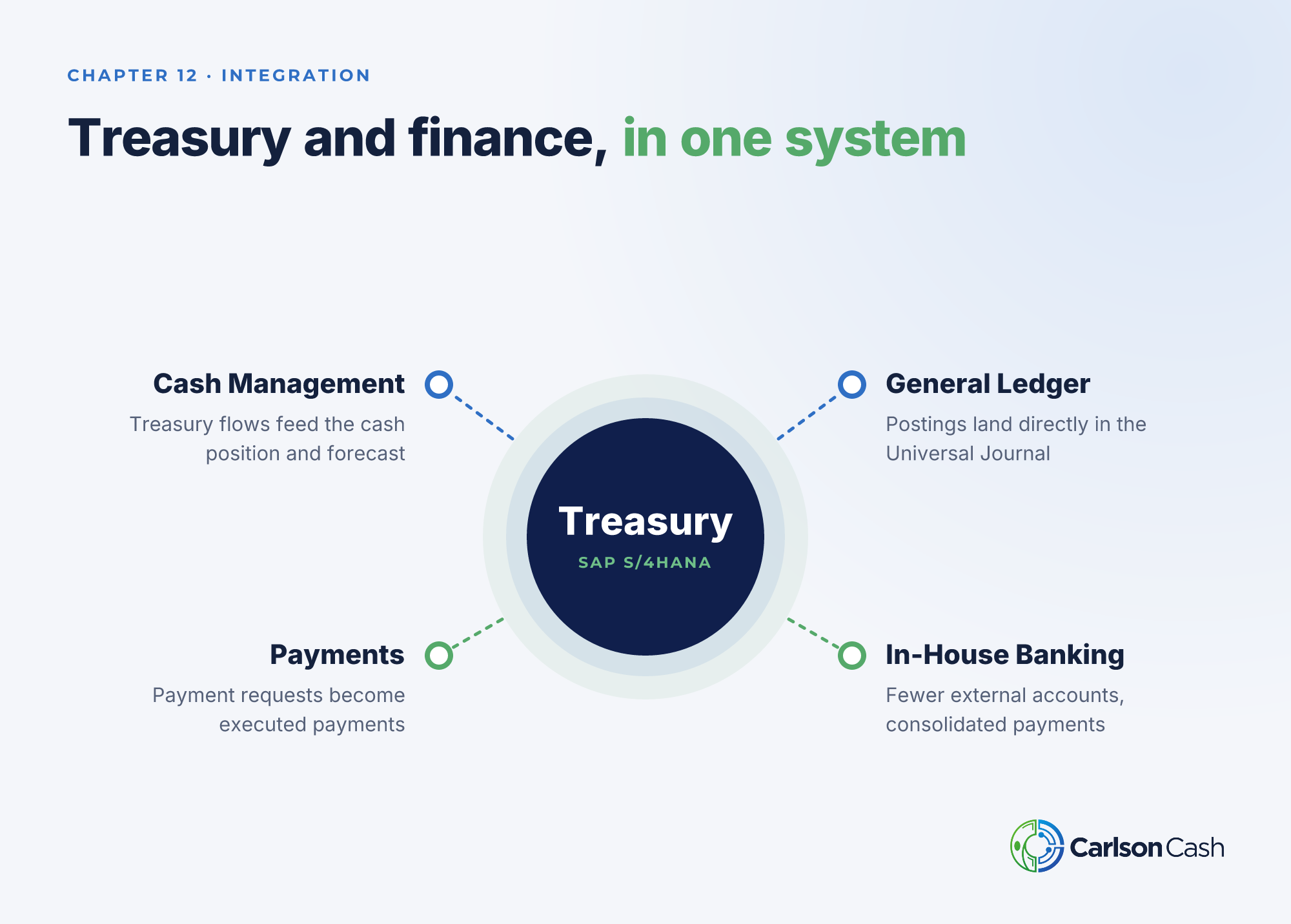
A major reason to run treasury in SAP S/4HANA is native integration. With treasury and finance in one system, there are no custom interfaces to maintain and no manual reconciliations to chase. Chapter 12 covers the key integration points and how to set each one up.
What you’ll learn:
- Cash Management: planning levels, update types, substitution and validation rules for treasury flows, and the Cash Flow Analyzer
- Accounting integration with the general ledger
- Payments: flow types, posting specifications, GL account assignment, contract payment details, and how payment requests become executed payments
- In-House Cash and In-House Banking, the differences between them, and how both help reduce the number of external bank accounts and consolidate external payments
Chapter 13: Reports, Key Performance Indicators, and Alerts
Entering transactions is only half the job. You also need to report on them, both in summary and at the detail level, to confirm that flows were calculated and recorded correctly. Chapter 13 covers the reporting SAP delivers as standard and how to use it.
What you’ll learn:
- Standard SAP Fiori reports, including Treasury Position History, Treasury Position Values, the Treasury Posting Journal, the Debt and Investment Maturity Profile, the Foreign Exchange Overview, Credit Line Analysis, and the Cash Flow Analyzer
- SAP Fiori analysis reports, and how to filter and design them for your own needs
- The classic SAP GUI reports that are still available, including transaction journals, release status and change documents, facility utilization, and collective processing reports for money market and FX
- How to surface legacy GUI reports as SAP Fiori tiles so users have one place to work
Why we wrote it
Learning SAP S/4HANA treasury for the first time can feel like building a house from an incomplete blueprint. You can understand the framing or the wiring on its own and still not see how the whole structure fits together. This book is meant to be the complete blueprint. It explains each component in depth and shows how they combine into one integrated treasury system.
It’s also written from the point of view of people who started as novices and became experts the hard way. Throughout, we’ve included the practical tips and lessons learned that only come from delivering real projects.
Get the book, or get the authors
Treasury and Risk Management with SAP S/4HANA: The Comprehensive Guide is available in print and e-book from SAP PRESS.
If you’re planning an SAP treasury implementation, moving to SAP S/4HANA, or trying to get more out of a system that isn’t delivering, we’d welcome a conversation. Implementing SAP Treasury is what we do every day at Carlson Cash, and our in-house team handles every project directly. Get in touch to talk through what you’re working on.

About Carlson Cash
SAP Treasury experts. We wrote the book.
Since 2017, we’ve had one focus: getting SAP Treasury right the first time. We’re hands-on treasury experts who’ve worked on both sides of the table, in consulting and in industry, with no outsourcing and no bloated teams. We wrote the SAP PRESS book Treasury and Risk Management with SAP S/4HANA, have led 50+ SAP treasury implementations across North America and Europe, and partner with global enterprises, Fortune 100 companies and public sector leaders, including fixing implementations others couldn’t.