
A practical guide to SAP MBC, BCM, and PMW—and how they fit together
Introduction
Payments and bank connectivity in SAP Treasury and AP are often described as complex. In reality, the architecture is structured and logical when you understand how the pieces fit together.
Challenges usually arise not from the technology itself, but from unclear definitions of roles within the overall SAP payment architecture. Terms like Bank Communication Management (BCM), Payment Medium Workbench (PMW), and Multi-Bank Connectivity (MBC) are frequently mentioned together — yet each plays a distinct and critical role in modern SAP S/4HANA Treasury implementations.
This article breaks down how these three components work individually and, more importantly, how they integrate seamlessly as part of a robust SAP Treasury payment process.
SAP Payments: A Layered Approach in SAP Treasury
SAP separates the payment process into three core responsibilities:
1. Creating and formatting the payment
2. Controlling and approving the payment
3. Transmitting the payment to the bank
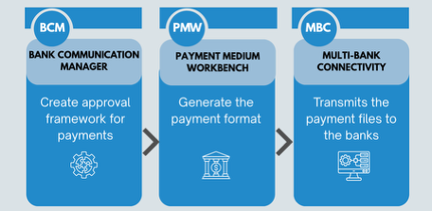
These responsibilities are handled by three components in SAP Treasury and Financial Supply Chain Management (FSCM):
• Bank Communication Management (BCM) → approval and control
• Payment Medium Workbench (PMW) → file creation
• Multi-Bank Connectivity (MBC) → bank connectivity
1. Bank Communication Management (BCM): Managing Approval and Control
Bank Communication Management (BCM) acts as the central dashboard for reviewing, approving, and monitoring payments in SAP Treasury. Once all required approvals are complete for a payment batch, BCM triggers the creation of the payment file.
BCM provides a centralized framework for:
• Multi-level payment approvals/rejections
• Release strategies with integrated workflow management
• Real-time monitoring of payment batches and statuses (including feedback from banking partners)
• Full auditability and compliance tracking
Key Capabilities:
• Multi-level approval workflows based on defined rules and amount limits
• Seamless integration with SAP Fiori for modern, user-friendly approval experiences
• Central visibility into payment batches from Accounts Payable, SAP Treasury, Payroll, and other sources
• Complete audit trail of all payment approvals
2. Payment Medium Workbench (PMW): Creating the Bank File in SAP Treasury
The Payment Medium Workbench (PMW) is responsible for generating the actual bank file that will be transmitted to your financial institutions.
It takes structured payment data from various SAP modules — including Accounts Payable, SAP Treasury, or Payroll — and converts it into a bank-ready format using flexible mapping rules.
Common formats include:
• ISO 20022 XML (pain.001)
• NACHA (ACH)
• MT101 and other legacy formats
• Country-specific and bank specific formats
Key Capabilities:
• Supports a wide range of country and bank-specific formats
• Provides a consistent framework for file generation across payment types
• Easy extensions and enhancements when needed
• Enables standardization and governance of payment formats across the organization
3. SAP Multi-Bank Connectivity (MBC): Connecting to the Banks
Once the payment is approved in Bank Communication Management (BCM) and the file is generated via Payment Medium Workbench (PMW), it must be securely transmitted to the bank. This is where SAP Multi-Bank Connectivity (MBC) comes in.
Multi-Bank Connectivity (MBC) is a cloud-based service that provides a single, centralized integration point between your SAP Treasury system and multiple external banks.
Key Capabilities:
• Connectivity to multiple banks through a single integration point
• Support for various communication protocols (e.g., SFTP, APIs, SWIFT)
• Secure transmission of payment files
• Support for both outbound payments and inbound bank statements
In Summary: This is the Simplified Process
1. Payments are created via SAP payment runs (e.g., F110/F111 or Treasury transactions)
2. Bank Communication Management (BCM) handles approval and release
3. Payment Medium Workbench (PMW) generates the bank file
4. Multi-Bank Connectivity (MBC) transmits the file securely to banking partners
A Practical Way to Think About the Architecture
• Payment Medium Workbench (PMW) → Focuses on how payments are built
• Bank Communication Management (BCM) → Focuses on how payments are controlled
• Multi-Bank Connectivity (MBC) → Focuses on how payments are delivered
Ready to Optimize Your SAP Payment Architecture?
Understanding the interplay between Bank Communication Management, Payment Medium Workbench, and Multi-Bank Connectivity is essential for achieving straight-through processing, stronger controls, and reduced risk in SAP Treasury.
At Carlson Cash, we specialize in SAP Treasury implementations focused on exactly these areas — from BCM approval workflows and PMW mapping to full MBC rollout and multi-bank connectivity.
Would you like help assessing your current payment architecture or designing a more efficient, future-ready solution? Feel free to reach out — we’d be happy to discuss your specific requirements.